
Why Most Hotels Cannot Prove Their Primary Channel Generates Revenue
If a hotel operator says they have email marketing but cannot prove hotel email marketing revenue attribution, that is a problem. Hotel email marketing revenue attribution must be verified, otherwise you do not own your email channel.
Email marketing sits inside almost every hotel marketing plan. Campaign calendars exist. Guest databases exist. Promotional messages go out regularly. Marketing teams report engagement metrics every month.
Evidence of activity is everywhere.
Evidence of revenue is much harder to find.
Open rates appear in dashboards. Click rates appear in campaign reports. Marketing teams describe strong engagement and growing lists. Numbers like these suggest progress.
Financial proof rarely accompanies those reports.
Revenue attribution often disappears once the conversation moves from marketing metrics to financial performance. Marketing teams show engagement data. Revenue managers examine occupancy, average daily rate, and total booking value. Systems tracking those numbers rarely connect in a way that reveals direct contribution.
Unknown unknowns begin there.
Decision science describes unknown unknowns as blind spots an organization does not realize exist. Known knowns represent information teams measure and understand. Known unknowns represent questions teams know they must answer. Unknown unknowns represent problems that remain invisible because the right question has never been asked.
Email marketing in hospitality often occupies that category.
Hotels believe email works.
Proof rarely reaches the level of incremental revenue.
The Measurement Illusion
Email marketing enjoys one of the strongest reputations in digital marketing. Numerous industry studies estimate that email generates between thirty-six and forty-two dollars in return for every dollar spent on marketing programs.[1]
Numbers like those create powerful expectations.
A marketing channel capable of generating forty times its investment should receive intense operational scrutiny. Marketing teams should be able to demonstrate clear financial performance.
Reality looks different in many hospitality organizations.
Hotels typically evaluate email marketing through engagement metrics. Open rates appear at the top of campaign reports. Click-through rates appear beside them. Engagement percentages often look healthy.
Hospitality email campaigns frequently report average open rates between twenty-five and twenty-seven percent.[2]
Metrics like those appear reassuring. Open rates, however, describe behavior rather than financial contribution. They do not help you verify hotel email marketing revenue attribution. At all.
An open rate confirms that a guest viewed a message in an inbox. An open rate does not confirm that the message generated revenue. A click rate confirms that a guest interacted with a link. A click rate does not confirm that the guest completed a booking. An open rate does not help you verify hotel email marketing revenue attribution.
Incremental revenue represents the only measurement that answers the real question.
Incremental revenue measures the revenue that occurred because of the campaign rather than revenue that would have happened anyway.
Most hospitality email programs never measure that difference.
What Unknown Unknowns Actually Mean
Unknown unknowns represent blind spots inside a measurement system.
Marketing dashboards typically display what the system can measure easily. Email platforms record opens, clicks, and unsubscribes. Marketing teams review those numbers after every campaign.
Systems that measure engagement rarely measure financial contribution.
Unknown unknowns appear when teams rely on engagement metrics as proof of performance. Metrics become familiar. Reports appear consistent. Marketing teams feel confident in their interpretation of results.
Confidence masks blind spots.
Operators eventually ask a different question.
Did the campaign create additional bookings?
Many marketing systems cannot answer that question.
Why Email Should Be the Most Measurable Channel
Email marketing should be easier to measure than most digital channels.
Hotels control the audience through guest databases and loyalty programs. Hotels control the message through marketing automation systems. Hotels control the timing of campaigns and the structure of offers.
Email marketing also allows direct tracking of guest interactions with a property website.
Those characteristics explain why email is often described as an owned channel.
Owned channels matter in hospitality because hotels spend enormous sums acquiring guests through intermediaries. Online travel agencies, advertising platforms, and metasearch networks all sit between the hotel and the guest.
Commission payments and advertising costs reduce the profitability of those channels.
Email marketing should reduce that dependence by generating direct bookings.
Measurement failures prevent many hotels from recognizing whether that outcome occurs.
Activity Metrics Versus Contribution Metrics
Marketing teams frequently focus on activity metrics.
Open rates measure engagement. Click rates measure interaction. Campaign frequency measures marketing activity. List growth measures audience expansion.
Activity metrics describe what the marketing department does.
Contribution metrics describe what the business earns.
Contribution metrics include bookings, revenue per guest, lifetime value, and incremental revenue generated by marketing campaigns.
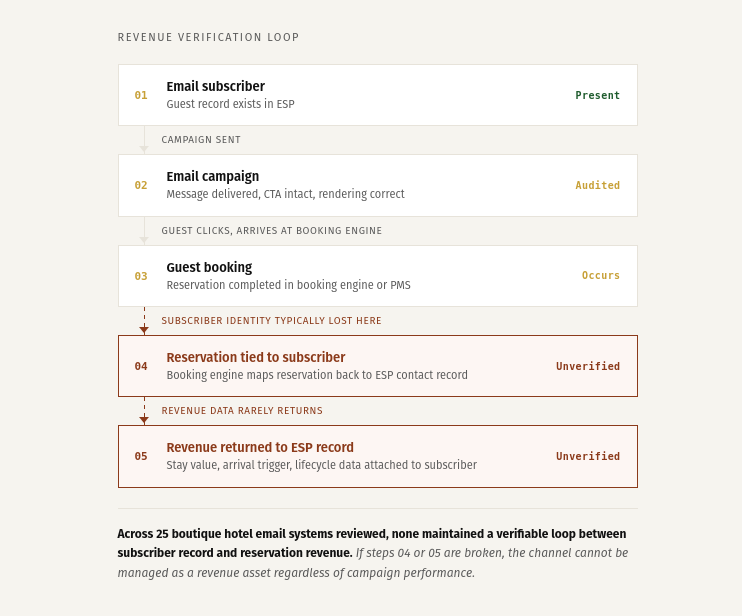
Hospitality organizations often separate those measurements across different systems.
Marketing dashboards track engagement. Revenue management systems track occupancy and pricing. Customer databases track guest information. Booking engines record transactions.
Integration rarely occurs.
Attribution becomes interpretation when measurement systems remain disconnected.
Marketing teams claim influence over bookings following campaigns. Revenue managers attribute those bookings to underlying demand patterns.
Both interpretations may contain partial truth.
Neither interpretation proves financial contribution.
The Email Revenue Attribution Problem in Hospitality
Attribution attempts to identify the marketing action responsible for a booking.
Booking journeys rarely follow simple paths.
A guest may open an email on a phone while commuting. Later research may occur through a search engine on a laptop. Price comparisons may occur through an online travel agency. The booking itself may occur days later through the hotel website or a phone call.
Multiple marketing channels influence the journey.
Hospitality research demonstrates that accurate attribution requires integrating online and offline data sources in order to reconstruct the full booking path.[3]
Attribution systems that lack integration often produce misleading conclusions.
Every channel appears influential.
Few channels can prove causation.
Unknown unknowns thrive in that environment.
When Measurement Fails, Stories Replace Evidence
Marketing reports often compensate for measurement gaps with narrative.
Teams describe strong engagement. Teams highlight positive guest responses. Teams interpret campaign performance through anecdotal feedback.
Stories feel persuasive because they resemble proof.
Stories do not appear on financial statements.
Operators require evidence that marketing activity produces measurable financial outcomes.
Communication alone does not justify marketing investment.
Contribution justifies marketing investment.
Hotels unable to demonstrate incremental revenue from email effectively operate a communication channel rather than a revenue channel.
The Financial Cost of Blind Spots
Measurement blind spots create economic consequences for hospitality businesses.
Marketing budgets naturally move toward channels that appear to perform well. Channels with clear reporting often receive additional investment. Channels with ambiguous measurement frequently receive less strategic attention.
Direct booking strategies illustrate the stakes.
Industry research consistently shows that increasing direct bookings improves hotel profitability because direct reservations avoid commission payments to intermediaries.[4]
Email marketing should support those bookings because it targets past guests and high-intent audiences.
Measurement problems prevent many hotels from seeing the channel’s true contribution.
Email becomes operational overhead rather than a strategic revenue engine.
Why These Blind Spots Persist
Technology fragmentation represents the most common cause.
Customer relationship management systems, booking engines, marketing platforms, and analytics tools frequently operate independently. Data rarely flows smoothly between them.
Privacy changes represent another factor. Email privacy protections introduced by major technology companies have reduced the reliability of open rate measurements.[5]
Organizational silos contribute to the problem as well. Marketing teams optimize campaigns. Revenue management teams optimize pricing and occupancy. Collaboration rarely extends to shared measurement frameworks.
Data overload further complicates interpretation. Modern hospitality systems produce enormous amounts of guest data. Organizations often struggle to convert that information into actionable insight.[6]
Unknown unknowns flourish in environments where data exists but interpretation remains weak.
Turning Unknown Unknowns into Known Problems
Operators cannot eliminate uncertainty.
Operators can reduce blind spots.
Incrementality testing compares booking behavior between guests who receive a campaign and guests who do not. Differences between those groups reveal whether the campaign created additional revenue.
Lifecycle measurement tracks guest spending across multiple stays. Many marketing programs influence revenue months after the original campaign.
Segment analysis identifies guest groups producing meaningful long-term value.
Integrated attribution systems combine behavioral data with booking transactions to reconstruct the guest journey.
Perfect measurement rarely exists.
Directional clarity provides enormous strategic advantage.
The Operator Perspective
Marketing conversations often revolve around inspiration and creativity.
Operators approach marketing channels differently.
Operators inspect systems.
Operators ask where revenue originates. Operators examine the channels they control. Operators demand financial evidence before expanding marketing investment.
Owned channels must produce measurable return.
Ownership without measurement creates the worst possible outcome. Businesses bear the cost of maintaining the channel without receiving the benefit of control.
Inspection reveals the truth.
Conclusion
Most hotels say they have email.
Few hotels can prove it generates revenue.
The difference lies in measurement.
Unknown unknowns disappear once operators begin examining the systems they believe they control. Blind spots become visible when marketing activity connects to financial contribution.
Contribution ultimately defines marketing success in hospitality.
Revenue appears on the profit and loss statement.
Stories do not.
Footnotes
- Litmus. The ROI of Email Marketing. Industry studies frequently report email ROI between $36 and $42 for every dollar invested.
- Benchmark Email. Hospitality Email Marketing Benchmarks. Hospitality email open rates typically average between 25% and 27%.
- Teradata. Integrated Marketing Attribution in Hospitality. Research highlights the importance of combining online and offline data to understand booking journeys.
- HospitalityNet. The Economics of Direct Bookings. Direct bookings increase profitability by reducing intermediary commission costs.
- Apple Mail Privacy Protection documentation on the impact of privacy changes on email open rate measurement.
- HospitalityNet. Data Overload to ROI in Hospitality Marketing. Research describing the challenge of converting hospitality data into actionable marketing insight.